




MY STORY OF THE BEGINNINGS OF THE ATELIERS VARAN
Jean-Noël Cristiani, Paris, February 14, 2025
This is a first-person account of the origins of the Ateliers Varan. I hope everyone can find something to relate to in it.
“Turn off the TV. Open your eyes.”
In May 1968, at the General Assembly of Cinema, the “absolute necessity to put cinema at the service of the people” sparked debates about transmission. Jean-Pierre Beauviala, through his “analysis of the tools at our disposal,” helped set in motion what might otherwise have remained a mere dream. Jean Rouch introduced ideas born from his own learning and teaching experiences. Official television either ignored or shaped people’s lives in a predetermined way. Rouch envisioned an international network broadcasting films made by the people themselves. Expressing oneself through cinema, going beyond standardized analytical frameworks, was based on a technical innovation that appeared in 1965: Super 8mm. Rouch relived the renaissance of a few years earlier, in 1960, with the emergence of “direct cinema.” Filmmakers were tinkering with or experimenting on portable, synchronous filming equipment invented to free them from many constraints. The Super 8mm format, with its new lightweight, portable amateur cameras, was financially more accessible than 16mm. Riding the wave of ’68, and as the first step of his project, Rouch created the first practical documentary filmmaking course at the University of Paris X Nanterre during the 1968-69 academic year.
FILM TEACHING AT THE UNIVERSITY, “The Back Wall”
Classes took place on Fridays. In the mornings, Jean Rouch would screen his history of cinema. Slapstick films always preceded documentary films. He connected subversive laughter and the technical precision of comedy with the boldness of his “totemic ancestors.” He knew how to bring to life the adventure and documentary revolution of Flaherty, whom he had known. Vertov, whom he admired for his rhapsodic films, opened up the vast experimental diversity of cinema vérité. During these morning sessions, Jean Rouch allowed us to discover the treasures of cinema without prescribing any model. He inspired a desire to continue exploring through daily visits to the Cinémathèque. That’s what we did, replacing university lectures with the screenings organized by Henri Langlois. At the Cinémathèque, you could see every film thanks to “this dragon guarding our treasures,” as Jean Cocteau called it. Going to the Cinémathèque awakened, enlightened, and nourished us. Wim Wenders said, “The best school in the world is in Paris. It’s the Cinémathèque Française.” We were lucky to have this kind of unofficial school.
Getting familiar with your tool requires knowing every detail of the camera’s mechanics. Internalizing the unit of measurement—the 3-minute film reels—helps develop a sense of duration. In the afternoons, Roger Morillère, a camera operator, would bring us a different 16mm camera each time from his collection and have us take it apart and put it back together. This way, we got hands-on experience with a wide range of equipment. Philippe Boucher, a sound engineer, introduced us to the portable Nagra tape recorder. For budget reasons, the university acquired only one piece of equipment: a portable amateur video set launched in 1967, consisting of a videocassette recorder and a camera. Playing around with this portable set on the faculty lawn, under the playful direction of Vincent and Séverin Blanchet, combined with a gymnastics course devised by Jean Rouch and Xavier de France, made up for the lack of equipment. A filmmaker must have “good footwork.” Freedom also comes from there. We knew of Rouch’s affinity for Rimbaud, “the man with soles of wind,” whose poems Rouch always kept in his pocket. Every Friday evening, we would advance toward the back wall of the long faculty hallway with a flashlight strapped to our forehead. By the end of the year, as the beam of light projected on the wall became almost steady, he crowned us “filmmakers.” And we believed it! And we dared to make films.
JEAN ROUCH’S PEDAGOGY: “Making Mistakes with Enthusiasm”
What connection can there be between documentary cinema and slapstick comedy? To beginners who are afraid of disturbing the characters and their daily lives with a camera and microphone, the sorcerer Jean Rouch gives a talisman. How can you open up reality, how can you enter it, amplify its dynamics and make it visible if you are paralyzed by the myth of objectivity and afraid of disturbing by your presence? The slapstick character disrupts order through the apparent clumsiness of their body, which in fact are acrobatic movements. “I’m more interested in provoking reality by the presence of the camera than in pretending to film reality as it is,” Rouch declares. When editing Les maîtres fous with Suzanne Baron, editor of Jacques Tati’s Monsieur Hulot’s Holiday, he meets the master. Jacques Tati would come every evening to trim a shot by a few frames to strengthen a gag in his film showing in theaters. He demonstrated to Rouch that rhythmic perfection is essential to the power of slapstick, a model of precision in cinematic art. The laughter comes from physical training inherited from the circus arts, music hall, and sleight of hand… Mack Sennett, creator of this cinema, was an actor, dancer, and acrobat. “Slapstick is surrealist lyricism,” said Robert Desnos. Disorder is the liberating dream, and this is the cinema of that dream. Rouch was close to the Surrealists. I understand better the mixture of fantasy, freedom, and discipline that Rouch breathes into his teaching and that his team shares. “He made mistakes with enthusiasm,” said a colleague, Philippe Constantini, quoting Colette. Rouch leads by example. His motto is “Why not?” If you don’t let mistakes in, how will the truth enter?
Teaching at the university was not Jean Rouch’s first pedagogical experience. In 1956, he founded the International Committee of Cinema and Television (CICT) in Venice with Roberto Rossellini. Together, they organized a collective creative workshop that brought together the future directors of the Nouvelle Vague. Other workshops followed in Africa. With us, Rouch used the old Malian oral tradition of “joking kinship,” which allows members of the same family to mock each other without consequence. Through this means of social relaxation, he taught his students a way to get closer to others through shared laughter that builds trust.
TEACHING THROUGH PRACTICE
Rouch chose to teach cinema the way he himself had learned it: by doing it. His discovery of cinematography while making his first film was combined with his frequent visits to the Cinémathèque. A young engineer graduated from the École des Ponts et Chaussées, Rouch escaped occupied France for Africa. He joined the Leclerc Division and was sent to Berlin as head of an engineering reconnaissance patrol. On the black market, he found an Arriflex camera and 35mm Perutz film in exchange for a carton of beef and beans. He wrote a poem and wanted to make a film, Color of Time, Berlin August 1945. On leave in Paris, he went to seek advice from Jean Cocteau. The master taught him that he should film with a professional crew—a camera operator, a director of photography, a sound truck with technicians… The heaviness of this put out the enthusiasm of the novice.
At the end of the war, he returned to Paris. He looked for work with his former boss, who had collaborated and helped build the Atlantic Wall.
- “What did you do during those four years?”
- “I fought in the war,” Rouch replied.
- “What a waste of time!”
Rouch stood up and left without a word.
- “I had paid my debt to France. I was free!”
With two friends, he decided to travel down the Niger River by canoe. “Our rule of life was to do what we loved…” They worked as correspondents for Agence France Presse, and Rouch filmed. He didn’t know how to make a film. He sought advice from friends. Jean Lods, co-founder of the IDHEC film school, “who wanted to help us, told us, you should go with operators… The same story as Cocteau!” A friend, Edmond Séchan, advised, “Go to the flea market; you can find cameras there.” He bought a camera “for a thousand francs” (about 140 euros). At that time, 16mm was the format for home movies. American soldiers had filmed battles, the landing, and the liberation of the camps with small amateur 16mm cameras—without sound. When filmmakers like Samuel Fuller, John Huston, George Stevens, and other engaged directors left, many sold their Bell and Howell cameras at the flea market. That’s the kind Rouch bought. Unlike American filmmakers who returned to Hollywood to work in studio cinema and face the industry from within, Jean Rouch bypassed the industry’s conventions. His work opened a path outside the studio and “French quality” standards.
In 1946, a plane took the three adventurers and a team of young explorers to Africa, with their friend Edmond Séchan as the cameraman. During a stop in the desert, the plane failed to take off. While it was being repaired, Edmond Séchan gave some private lessons to the young beginner Rouch. He taught him how to load the camera, clean it, properly preserve film in hot and humid climates, and some other basic instructions. That was enough for Rouch to dive into cinematography without attending film school, driven by urgency and inspiration. He learned by doing, following the principle: knowledge is acquired through making mistakes. On the day of departure, as the team boarded the canoe, the novice dropped the tripod foot into the Niger River. He would never film with a tripod. Sometimes film professionals were irritated by the technical imperfections of certain shots — tilted horizons, unusual editing cuts, the chaotic look of films subject to the contingencies of the moment and improvisation. It is precisely this unfinished, even “shabby” quality of his cinema, these traits he cherished above all else, that left him on the margins of the “major cinema”… Les Maîtres Fous, Moi, un Noir, La Pyramide humaine, Chronique d’un été threw a stone into the pond of film schools. It was a challenge to all professionals, to everyone who thought they knew, rightly or wrongly, how films should be made,” writes Jean-Paul Colleyn.
Centuries earlier, Jean-Honoré Fragonard, accused of obscenity, responded: “Obscenity is licking.”
Jean Rouch confides that because of this lost tripod foot, he discovered a different presence in the world. “The camera becomes as alive as the people it films…” says Rouch. What Friedrich Wilhelm Murnau already announced in 1924 with die entfesselte Kamera, the “unchained camera.” In the young Jean Rouch, there was the meeting of the spirit of the Resistance, the liberating anger against political compromises, and all the possibilities offered by the lightweight techniques of amateur cinema. The beginner reconnects with the original dream of cinematography — a free and moving spirit and body.
“Sharing my view”
French newsreels bought Rouch’s footage. The professionals eliminated many flaws, added pseudo-African music and images of animals that did not live by the great river. The Tour de France commentator said: “In the land of the black mages,” with the condescension due to “savages.” Although seeing professionals at work helped him understand some dramaturgy and editing techniques, Rouch felt he had betrayed his African friends. This manipulation served to propagate “France’s civilizing mission.” After this painful initiation, he swore revenge: “I was furious. It went against everything we had to fight. I was ashamed. I would never dare show this film to my Nigerien friends. The black man of that time was a humiliated black man, completely naked. We had to start over, taking the time to make another film, to show an Africa that needed to be discovered. To discover means to know. To know, I had to share my view with the people I had watched.”
“A cheapened cinema”
On Friday evenings, after the university cinema class, the Blanchet family warmly welcomed us to their home on Quai Bourbon. Often present were Jean Rouch, Jean-Pierre Beauviala, Jacques d’Arthuys, students from Paris X, François Pain, André Van In. During nights fueled by Gris Meunier wine, we imagined projects and ways to realize them. The festive spirit of our gatherings seemed essential to everything we would accomplish together. We dreamed of bypassing the ideology of official television, and “that new tools would allow peoples to express their cultural identities.” In 1977, the young Republic of Mozambique was caught in a civil war. The government decided to establish a film infrastructure entirely dedicated to the revolution and popular development. The French cultural attaché Jacques d’Arthuys wanted his friend Jean Rouch to join this initiative. During a first visit in 1977, the shooting of a film was organized in a self-managed brewery. It was both a way to connect with the working world and a technical demonstration for the film students of the National Film Institute, showing a long take filmed with a 16mm camera. The following year, Mozambique invited well-known filmmakers to film the country. Rouch responded that he would not make a film. Instead, he proposed that Mozambicans themselves, non-filmmakers, should film after a brief introduction to the equipment in a workshop. Cinematography is not taught through models or traditional lectures. Knowledge is not detached from experience or desire. It becomes embodied in each individual through taking action, through creating. A documentary film workshop based on practice was created. During this production experience, from June to September 1978, Rouch confirmed his teaching method with a full Super 8mm setup — cameras, lab, projector, and editing viewers. Françoise Foucault recalls the schedule: “We shoot in the morning, develop at noon, edit in the afternoon, and screen in the evening.” Each shoot was screened and discussed, allowing reflection before the next shooting. This is where a fundamental reversal occurs in cinéma vérité: “It’s what I find that teaches me what I seek,” as the painter Pierre Soulages said. Like a river, reality follows its own course. Each filmmaker made their own film, Mozambicans bearing witness to their own reality. This kind of popular workshop did not suit the National Film Institute, which favored more “professional” films. Jacques d’Arthuys summarized the criticisms heard: “It is commonly said that Super 8 is a cheapened cinema, and almost all professionals reiterated this about the work done in Maputo… Another set of criticisms: the Mozambique experience is demagogic, there is no cinema without specialization, without developed knowledge, without hierarchy… A communications specialist judged it neo-colonial because it was funded by the French Ministry of Foreign Affairs. This was not the opinion of Mozambican Television, which, for its inauguration in 1979, chose the complete series of films made by the Workshop.” All these objections fueled our enthusiasm and triggered the adventure of the Ateliers Varan. This workshop, supervised by film students from Paris X, inspired the pedagogy of the first summer 1980 training session of what would become Varan.
THE UNIQUENESS OF VARAN
“Long before so many film schools were established across the globe, and at a time when a lively and vibrant cinema of autonomy—called ‘light,’ ‘direct,’ or in short, a very artisanal cinema in 16mm with synchronous direct sound—was continuously being experimented with, and while Jean Rouch, Jean-Luc Godard, Pierre Perrault, John Cassavetes, and Eric Rohmer, to name just a few, had been filming in this way for ten or fifteen years, the Ateliers Varan took on the mission not only to train young filmmakers from around the world but to train them to become trainers themselves. The singularity of Varan lies primarily in this happy loop that connects learning and practice.” — Jean-Louis Comolli
At the Ministry of Foreign Affairs, Jean Rouch and Jacques d’Arthuys secured an agreement to hold an international documentary filmmaking training workshop in Paris. Embassies were mobilized and sent scholarship recipients from South America, Madagascar, and elsewhere. A large apartment on Rue d’Iéna was made available. The workshop was conducted using Super 8mm equipment. Jean Rouch, along with his assistant and collaborator at Paris X, Vincent Blanchet, called upon Philippe Costantini, Nadine Wanono, Dominique Terre returning from Mozambique, and other former Paris X students and filmmakers such as Alain Martenot and myself. André Van In, despite his experience making the film Geel with Vincent, had to play the role of the Belgian trainee so that we could receive full support from the Ministry. He performed his part very well. At the urgent and unanimous request of the students he had kindly assisted as a course instructor alongside his brother Vincent, Séverin Blanchet was brought in as a trainer. Jean Rouch occasionally attended rushes screenings with his friend Enrico Fulchignoni. Too busy with his own films, Rouch intervened little but continuously supported the group. Jean-Pierre Beauviala gave a luminous and memorable course on optics and mechanics. The workshop unfolded in two separate rooms, representing two pedagogical approaches. Vincent Blanchet hung hammocks in the large living room. Together with Jacques d’Arthuys, they “preached,” sometimes lying down, the humanistic and revolutionary values of documentary cinema. They thus revived the original May ’68 project of “the absolute necessity of putting cinema at the service of the people.” The mission of this workshop, and all those that followed, was “not only to train young filmmakers from around the world but to train them to become trainers themselves.” After these pleas, Vincent demonstrated the equipment and launched his group into shooting a film jointly directed by the four South American trainees, La princesse Mimi. Many scenes featured Béton Vibré, the rock band of Vincent and Séverin.
In another room, Séverin Blanchet, the veterans from Mozambique, and I developed a different method. We synthesized the training from Mozambique and my experience from three workshops conducted at the request of the Cinéma Lux in Caen. The trainees defined their film subjects. We distributed up to four 3-minute film cartridges according to the sequences to be shot, each described in advance. The films to be developed were taken each evening to the Kodak lab in Sevran, in the Paris region. The next day, we all watched the rushes together. We were delighted to see images different from the pre-shoot descriptions. We discussed them before the next shooting session. Answering a request for a tracking shot, Vincent brought roller skates. He led the trainees rushing through the rooms at full speed, sometimes falling right in front of the screen during the projection… Vincent thus inaugurated a series of surprising improvised modifications on the equipment that he performed live in the classroom. This ingenious practice continues the dynamic of the early days of direct cinema, where inventiveness went hand in hand with a love of the unexpected. The Maysles brothers built their camera from parts of other cameras. Jean Rouch rigged his tracking rigs. A pirogue on the Niger River, a wheelbarrow, preluded the 2CV pushed in 1961 by Michel Brault and Rouch for the tracking shot of Chronique d’un été.
Vincent Sorel recounts: “Filmed with a backward tracking shot, Marceline Loridan walks toward the camera… the Cameflex is placed inside Rouch’s 2CV: blocked at the bottom of the trunk, the camera’s viewfinder is then obstructed. Brault and Rouch, each leaning on one of the car’s fenders, abandoned the camera to push the vehicle, which they then let roll away and stop on its own. …Even though their equipment was prepared by André Coutant — who designed the Cameflex at Éclair — the synchronization remained very approximate. …While the technical goal was to shoot directly what was being filmed (reflex viewing being part of the ideal setup), this emblematic sequence of the beginnings of direct cinema was not only shot blindly, but the filmmakers could not hear what Marceline was saying. The sound is direct, image and sound being recorded simultaneously and together, yet the synchronization was artisanal…”
During this workshop, the trainers sit down with the filmmakers at editing stations. Elisabeth Kapnist, editor and director, joins the group. One of the driving forces of our pedagogy is also the festive evenings we spend all together, which often cause delays in the morning classes. In this disordered and creative bubbling, each trainee in our group makes their own film on Super 8mm. The 9 films offer diverse and powerful images of life in Paris. A workshop film, Under the Mirabeau Bridge, by the young Malagasy poet Elie Rajaonarison, sparks a violent controversy among us. It reveals the different cinematographic tendencies present within the Varan group. The filmmaker chooses to recite a prose poem, superb in its sweetness and revolt against the fascination exercised by the culture of the former colonial power. His voice-over, echoing verses from Apollinaire, is paired with images that include sequences of life filmed in direct cinema style. The voice-over and images inspired by the words are considered heterodox. We all feel inspired by direct cinema. The ethics of the relationship between filmer and filmed seems essential to all of us. Should every individual and culture be interpreted in direct cinema, or should expression be left unaltered? Those defending the strict practice of direct cinema in training debate with those who accept an “impure direct cinema.” They cite Jean Rouch’s films, with his storyteller’s voice and playful staging. He was one of the pioneers of direct cinema. The autonomy given by this movement amplified his creative freedom both in the cinema of the real and in fiction, comedy, and storytelling.
To theorize or shed light on certain aspects of cinema history is seen as a risk of standardizing and distorting particular identities and “inspiration of the moment” in favor of fixed models. Some of us do not share this mistrust toward knowledge. Henri Langlois, founder of the Cinémathèque Française, is one of them. Born in Izmir, he said that films, like carpets, must be taken out and shown to stay alive. Langlois created miraculous programs. His poetic sense revealed the magic of cinema, which he called “the art of sleep.”
“I never say: this film is good, this film is bad. They discover it for themselves. I never help them, I never teach them anything. I put food on the table, they take it, they eat it, and they keep on eating. All I do is keep giving them food, again and again.”
Confident in the digestive capacities of the trainees, Pierre Baudry was able to lead a seminar during the next workshop. Then Jean Rouch presented his history of cinema in partnership with the Cinémathèque Française. Thus opened the possibility for Varan to become a place of reflection on cinéma du réel (cinema of the real).
THE NAME VARAN, The Marsupilami Thieves
Like many groups, our ideological life was turbulent. Meetings and debates followed one another, along with exclusions, departures, and the arrival of new members. André Van In, who had been with us from the start, was officially recognized. He brought in Pierre Baudry. During the second workshop in 1981, we looked for a name for the group but couldn’t find one. An Egyptian student of Jean Rouch hinted at the creation of a workshop in Egypt. We all dreamed of going to the banks of the Nile. Two of our new colleagues, Jean-Loïc Portron and Séverin Blanchet, comic book readers, combined our wishes with their encyclopedic knowledge of the adventures of Spirou and Fantasio. In The Marsupilami Thieves, a monitor lizard (a varan) escapes from a zoo shouting “Quick, to the Nile!” We felt like that varan. Our name was found. The workshop in Egypt happened… thirty years later.
The Ateliers Varan also have an economic and administrative reality. Administrator Chantal Roussel and president Jean-Pierre Beauviala ensure the necessary organization of this exuberant group. They saved Varan many times from shipwrecks and bankruptcies. The torch has been passed down to this day with the same rigor and commitment.
MODERNITY OF CINÉMA DIRECT
The necessity to invent a new filming setup to shoot up close, alongside the subjects, has existed since the very origin of cinema. For many years, filmmakers had to forgo synchronous sound in order to preserve the unique presence allowed by lightweight or amateur cameras. Richard Leacock, who assisted Robert Flaherty on Louisiana Story, observed:
“I realized that when we worked with small cameras, we had exceptional mobility, we could do whatever we wanted, and we achieved a wonderful sense of cinema. But as soon as we had to film dialogue with synchronous sound, the whole nature of the film changed. It was as if the film stopped. We had very heavy disk recorders, and the camera became a kind of monster weighing a hundred kilos. Flaherty preferred this to post-synchronization, which only gives a false spontaneity. He was fully aware of this problem: it was impossible to properly film sound sequences where people talked to each other and conveyed their emotions… Nothing could be done until the invention of the transistor, which made sound equipment portable and allowed synchronization.” Young filmmakers from Quebec, the USA, and France began tinkering with or inspiring the invention of portable synchronous equipment. This movement of the late 1950s is what we call cinéma direct. In contact with the filmed reality, narratives and their forms reinvent themselves, the artist’s body participating in this writing thanks to lightweight equipment. Caroline Zeau defines it as follows: “In all cases, it is about reinventing cinema in contact with the world, reducing the burden of superfluous intermediaries (technical heaviness, professional usages), and giving up control of the filmed universe to reach — or regain — a quality of presence based on the principle of participation.”
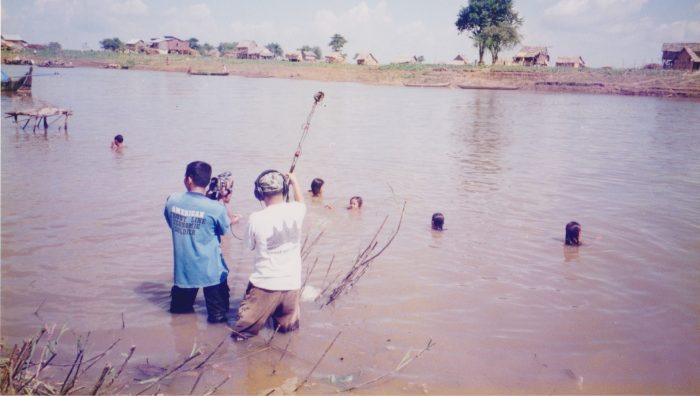
Since the origins of the Ateliers Varan in 1980, the training has been centered on cinéma direct. Today, our filming equipment and ways of shooting are the result of that history. Without being fully conscious of it when we film, we carry this entire history within us. The situation of some workshops echoes moments in the creation of this cinema. When the Varan Vietnam workshop began in 2004, national documentaries were images with voice-over narration. One effect of the workshop was to initiate synchronous cinema and replace official commentary with the voices of Vietnamese men and women. This was not always accepted by the censors. It recalls the beginnings of synchronous cinéma direct in the USA by young journalists saturated with documentaries where voice-over commentary rendered the images silent and useless. The project for a Varan Workshop in Sri Lanka in 2026 comes from the desire of a group of young Sri Lankan filmmakers to create and show a different cinema than the Hollywood-inspired films dominating the country’s festivals. We think of the Quiet Revolution of the 1950s, a movement of cultural reappropriation from which a new cinema was born in Quebec, at the NFB within the “French studio.” To give an idea of the documentary spirit prevailing at that time, it suffices to say that the sets of the National Film Board built in Montreal were exact replicas of the Hollywood studio model — only reduced to a quarter of the size. The aesthetic ideal and technical procedures, even in documentaries, were imitations of Hollywood studio cinema. Michel Brault, an inventive technician who joined the NFB as a cameraman and lighting technician, said, “I give myself two years to change all that.” In 1958, Les raquetteurs was the first film shot using a technique Brault developed: handheld camera. Marcel Carrière attempted synchronous shooting with the Sproketape recorder. Documentary filmmaking and cinema thereafter would never be the same.
Our colleague Marie-Claude Treilhou expresses the meaning of cinéma direct for learning at Varan:
“Isn’t it the only tool we have to make people understand what cinema is, what staging reality is, its shaping, what brings it close to fiction and precisely shakes all boundaries, questions them best… what guarantees the greatest accuracy and depth, the most subversive, what ‘testifies’ to the poetic depths of being, what sends the nervous (new watchword), hysterical practices of the most miserable television productions back to kindergarten, making us all ashamed? What resists time (upstream and downstream), the fury of utilitarianism, what restores dignity to this ‘game’ of all existence, ambiguous, complex, paradoxical? …To radically ban the interview principle from all workshop films…and only resort to it as a last resort? Let it be known that this is what one will find here.”
With his motto, Jean Rouch invites us to imagination and boldness: “Why not?”
Jean-Noël Cristiani, Paris, February 14, 2025